
Uganda

Subsidized Fertilizer

Watch Video

Tracking Time, Cost & Validity

Glossary

Agile Data Technologies

  • Computer Assisted Personal Interviews (CAPI)

    Computer Assisted Personal Interviews (CAPI) is a survey method where interviewers conduct face-to-face interviews using a handheld computer or tablet to ask questions and record responses. This technique enhances data accuracy and efficiency by allowing for real-time data entry and the use of complex question formats, making it effective for collecting detailed information in various research settings.

  • Computer Assisted Telephone Interviews (CATI)

    Computer Assisted Telephone Interviews (CATI) is a survey method where interviewers conduct telephone interviews using a computer system to manage questions and responses. This approach improves data accuracy and efficiency by reducing human error and allowing for immediate data entry. CATI is widely used in market research and public opinion polling to collect quantitative data from various respondents.

Agile Data Indicators

Time

  • Survey Duration

    The mean amount of time it takes for a respondent to complete a survey from start to finish (minutes). It is calculated by taking the total time spent by all respondents to complete the survey and dividing it by the number of respondents. This metric is important for assessing the survey’s efficiency.

  • Number of call attempts

    Number of calls made before receiving an answer,

Cost

  • Data Collection Cost

    The reduction in expenses achieved during the data collection phase of a research project compared to the standard costs.

  • Survey Cost

    The amount of money saved on each individual survey compared to the traditional survey mode (CAPI) cost per survey.

    This metric helps assess the financial efficiency of data collection on a per-unit basis, reflecting how much less it costs to collect data from each respondent.

Validity

  • Sample Size Reached

    The percentage of individuals that responded to the survey out of the total number of people in the sample.

  • Data Accuracy

    Inaccuracies or deviations between the recorded values and the true values of the variables being measured in a study.
    Sources of measurement errors include:

    • Respondent errors (e.g., misunderstanding questions, providing inaccurate responses).
    • Interviewer errors (e.g., inconsistent question delivery, leading the respondent).
    • Instrument errors (e.g., faulty survey tools, miscalibrated equipment).
    • Environmental factors (e.g., distractions during data collection).

    Minimizing measurement errors improves data quality and ensures that the findings of a study are more accurate and reliable.

  • Replacement Rate

    Refers to the percentage of individuals who were successfully reached by using phone numbers from a secondary or replacement list over the total number of realized interviews.

  • Reponse Rate

    The percentage of individuals that respond to the survey out of the total number of people invited to participate.

    It is a key indicator of the survey’s success and representativeness, reflecting how well the target population was reached and how engaged they were.

The Methodology

The Sustain Africa Fertilizer Initiative was launched to address the fertilizer supply deficit and rising cost crises in Africa through privately-led subsidies on fertilizers. The program consisted in applying discounts to fertilizer price. The fertilizer companies selected for this initiative have been Yara and ETG with discounts offered per bag of fertilizer equal to 30% and 25% of the original price, respectively.

Survey

Study research questions were chosen for a holistic approach exploring behavioral and non-behavioral attitudes of various agents involved in the program. The topics included: Accountability and Bureaucracy, Usage, Productivity, Inclusivity and Gender Inclusivity, Awareness, Demand and Supply, Price Affordability: WTP & Financing, Profitability & Economic benefits of the program, and Fertilizer decision mechanism.  Some questions were asked to either smallholders or agro dealers (specific questions). Other questions were asked to smallholders and agro dealers (common research questions).

Sampling

Smallholders and agro dealers were sampled by COSA through the lists of AFAP’s baseline farmers (i.e., farmers that AFAP interviewed in March-June 2022). COSA made a census of agro-dealers participating in the program; Census of AFAP’s list of ETG baseline farmers (443) plus a list of 200 replacements. Further AFAP’s list of Yara farmers (904 farmers) have been used by COSA to sample 454 farmers through stratified random sampling, but they have not been interviewed since Yara did not share telephone contacts of those farmers. COSA conducted the interviews for the production cycle of September-November 2022

Technology

Both smallholders and agro-dealers were interviewed using CATI (Computer Assisted Telephone Interviews).

Overview

Risk, Resilience and Climate

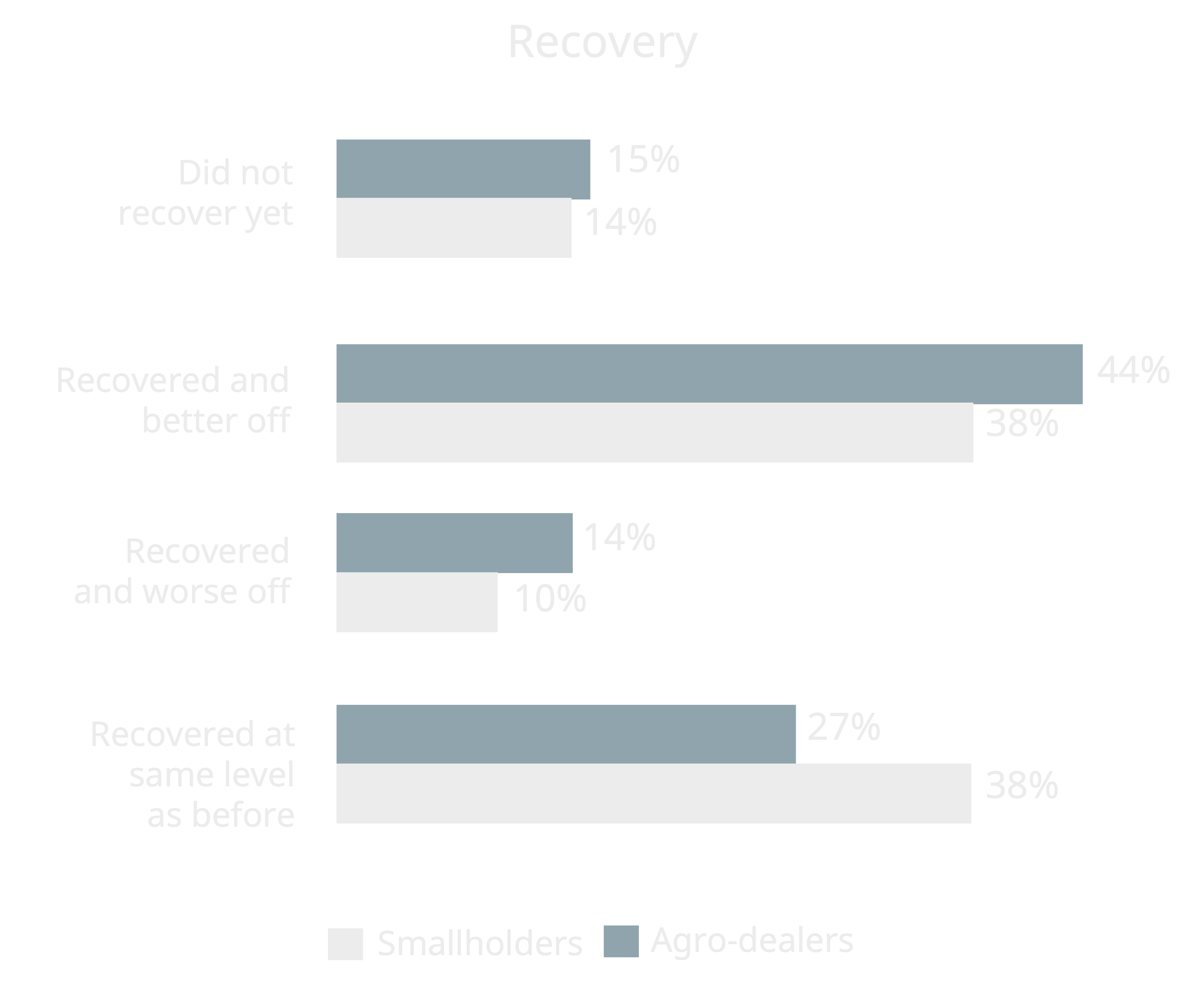
Resilience is the ability of individuals, households, and communities to prevent, resist, absorb, adapt, respond and recover positively, efficiently and effectively when faced with a wide range of risks, while maintaining an acceptable level of functioning without compromising long-term prospects for sustainable development, peace and security, human rights and well-being for all.
UN(2020)

Service Delivery

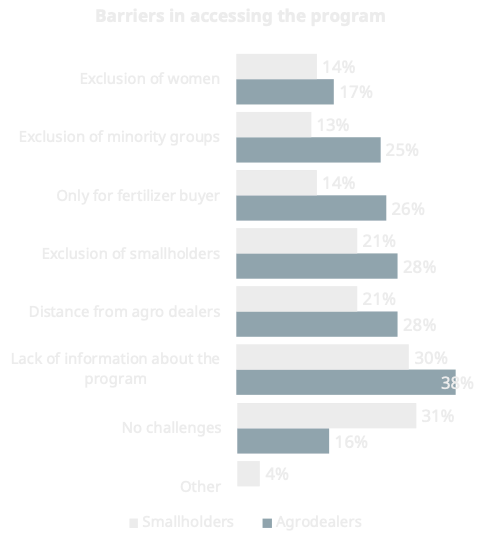
Service delivery encompasses the planning, implementation, and management of the program to ensure they meet the needs and expectations of the target audience. This includes aspects like accessibility, quality, efficiency, and inclusivity of the program.

The main perceived barrier to accessing the program for both smallholders and agro dealers was lack of information about the program (44% and 38% respectively).

Other important factors for both sets of participants were distance from agro dealers and exclusion of smallholders.
New Business Development

Business development involves strategies and activities aimed at enhancing their economic viability and market presence.

Access to credit refers to the ability of farmers to obtain loans or financial resources to fund agricultural activities, purchase inputs, or invest in farm improvements.
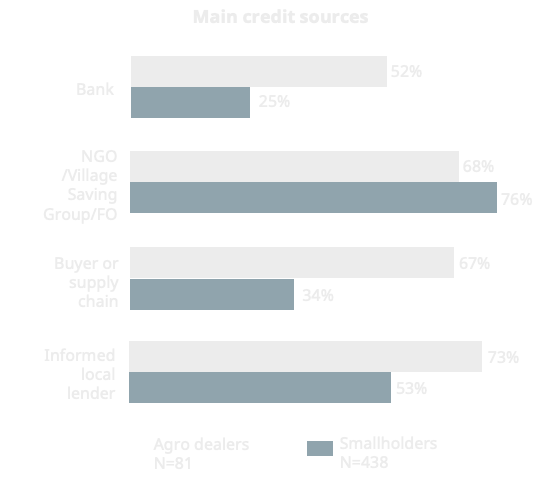
NGOs, village saving groups and farmer associations were an important credit source for both smallholders and agro dealers in percentage terms (76% and 68% respectively).


Productivity

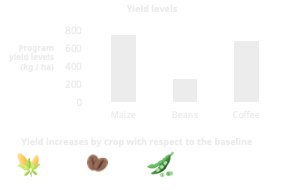
Productivity refers to the efficiency and effectiveness with which resources are utilized to produce crops. It encompasses various indicators that measure the output relative to inputs used.
Profitability

Profitability is a key measure of success and sustainability.

Indicators

The right data drives clear insights
COSA indicators are recognized for their practicality, precision, and ease of adoption, providing managers and researchers with clarity while minimizing data costs. Proven globally, these credible indicators are tested across thousands of applications, delivering science-based data on sustainability.